Views: 0 Author: Site Editor Publish Time: 2026-08-27 Origin: Site
Transitioning from generic office supplies to branded marketing assets demands careful attention to specific printing choices. When you invest in custom stationery, every detail reflects directly on your corporate identity. A poorly executed promotional item can quickly turn an exciting campaign into an embarrassment.
Choosing the wrong printing method, paper stock, or adhesive creates massive functional issues. You risk receiving products featuring curled edges, illegible branding, or notes failing to stick. These seemingly minor failures actively damage brand perception and waste valuable marketing budgets.
We provide a transparent, vendor-agnostic framework for evaluating modern printing techniques and material specifications. You will discover exactly how to navigate complex production variables with total confidence. This guide prepares you to smartly spec and order branded sticky notes for your next campaign.
You must evaluate your specific use cases before selecting a physical shape. Aligning the pad profile with your intended business outcome prevents wasted spend. You might need simple internal office utility. Alternatively, you might want high-impact trade show giveaways.
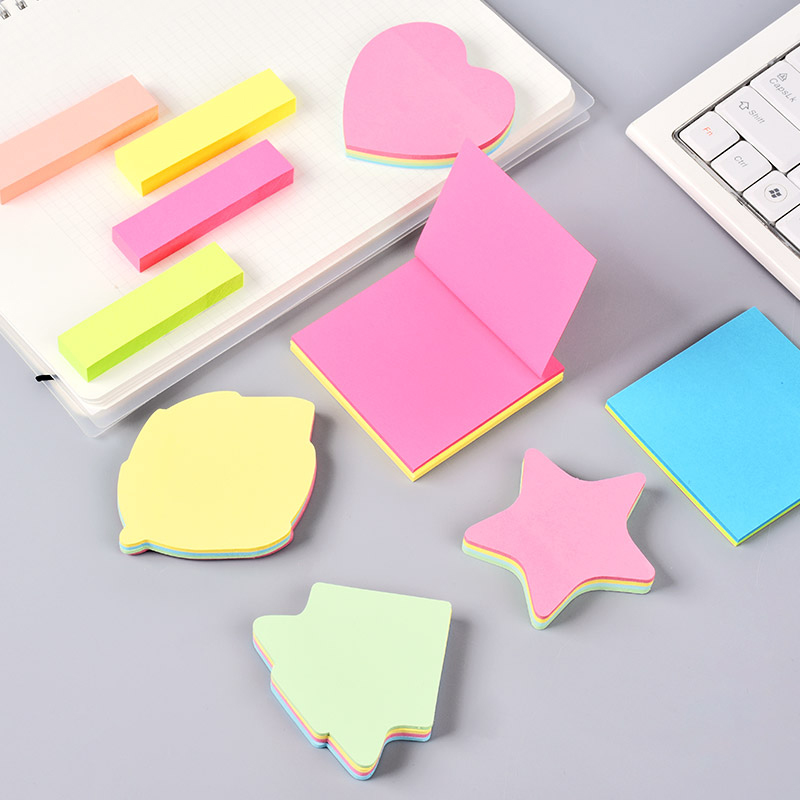
Most corporate buyers default to standard squares and rectangles. These traditional sticky note pads provide significant practical advantages. They maximize usable writing space for the end-user. They also offer the lowest cost-per-unit across all manufacturing tiers. Printers produce them incredibly fast due to standardized cutting processes.
Standard shapes work best for internal corporate use. They also excel during mass-distribution direct mail campaigns. You should rely on them for standard B2B client gifting. Practicality drives repeated use, keeping your brand visible on client desks for months.
Marketers often seek high novelty factors to capture attention. Using custom shape sticky notes delivers an immediately recognizable brand silhouette. You can design them shaped like a core product, a company logo, or a brand mascot. They disrupt the visual monotony of a standard office desk.
However, die-cutting introduces notable risks. The custom shape naturally reduces functional writing space. Irregular borders make it harder for users to jot down long messages. Furthermore, custom dies typically increase MOQs and setup costs. You should only select custom shapes if your primary goal involves top-of-funnel brand awareness. Do not choose them if you prioritize practical daily utility.
Understanding ink application ensures your brand colors print accurately. Printers generally offer two primary color systems. Each serves a distinct purpose depending on your artwork complexity.
The full-color process uses cyan, magenta, yellow, and black inks. Printers mix these four colors to create thousands of distinct shades. CMYK works best for gradients, photographic elements, and complex multi-color logos.
Implementation realities require careful consideration. Digital CMYK offers immense design versatility. Yet, it can sometimes result in slight color variations. You might notice minor shifts across large print runs. It rarely perfectly matches specific corporate colors compared to pre-mixed inks.
The Pantone Matching System remains essential for strict brand style guide compliance. PMS uses highly specific, pre-mixed ink formulas. This ensures exact corporate color replication across every single pad.
You should evaluate this through an ROI lens. PMS printing is generally more expensive for multi-color designs. Each custom color requires a separate printing plate. However, it guarantees your brand identity looks perfect every time.
Design risks often ruin the functionality of custom stationery. Printing a dark logo directly in the center of the pad creates a major problem. If you print at 100% opacity, you render the note completely unusable for writing.
You can easily solve this issue during the design phase. Specify a 10% to 15% opacity watermark for center placements. This keeps the logo visible but allows ink pens to read clearly over it. Alternatively, restrict solid color printing entirely to the margins. Headers and footers frame the writing space perfectly.
| Printing Method | Best Used For | Color Accuracy | Cost Implications |
|---|---|---|---|
| CMYK (Full-Color) | Photographs, gradients, complex designs | Good, but slight variations can occur | More cost-effective for multi-color art |
| PMS (Spot Color) | Strict corporate branding, solid colors | Perfect consistency across all runs | Higher cost per additional color used |
Physical materials determine how users perceive your promotional item. High-quality specifications ensure your branded product performs reliably in office environments.
Standard weight for premium Note Papers is typically 50 lb. to 60 lb. uncoated text. You must pay close attention to paper thickness. Thinner paper bleeds through easily. When users apply heavy ink pens or markers, the ink ruins the sheet underneath.
Uncoated stock is absolutely mandatory. Glossy or coated papers resist standard pen ink. They cause horrible smudging and frustrate the end-user. Uncoated paper ensures smooth writing and instant ink absorption.
Adhesive quality represents the biggest trust factor in this product category. You generally choose between standard adhesives and super-sticky formulations. Heavy-duty options function comparably to famous 3M Post-it® technology.
Implementation risks rise sharply with budget adhesives. Cheap adhesives dry out quickly in standard office conditions. This causes notes to curl upward. Eventually, they fall off vertical surfaces like computer monitors or whiteboards. You must specify premium adhesives for high-value client gifts.
Printers offer several standard thickness configurations. Typical options include 25, 50, or 100 sheets per pad. Your choice impacts unit cost and distribution logistics.
Corporate sustainability mandates continue to reshape promotional procurement. Many enterprise buyers now face strict environmental requirements. You must address these demands when ordering promotional items.
Printers evaluate green paper using Post-Consumer Waste (PCW) percentages. You will typically find options ranging from 30% to 100% PCW. Choosing recycled materials demonstrates robust corporate responsibility.
You must understand the visual trade-offs. Choosing 100% recycled paper often introduces a slightly off-white tint. You might also notice visible fibers embedded in the sheets. These physical characteristics can impact lighter CMYK color reproduction. Your pastel brand colors might look slightly muddy on heavy PCW stock.
Sustainability extends beyond just paper choices. You should inquire about environmentally friendly printing chemicals. Many modern facilities offer soy-based or vegetable-based inks. These replace traditional petroleum-based alternatives.
Additionally, you can specify water-based adhesives. These non-toxic glues break down easily during the paper recycling process. They ensure the entire product remains fully recyclable after use.
| Component | Standard Quality Option | Premium / Eco Option |
|---|---|---|
| Paper Weight | 50 lb. Uncoated Text | 60 lb. Uncoated Text or 100% PCW |
| Adhesive | Standard Water-Based | Super-Sticky / Heavy-Duty Formulation |
| Inks | Standard CMYK/PMS | Soy-based or Vegetable-based Inks |
Selecting the right vendor prevents costly production mistakes. You need a structured approach to manage minimums, artwork, and final approvals.
You must understand the manufacturing cost curve. Digital printing equipment allows for incredibly low MOQs. You can often order just 10 to 50 pads for small teams. However, digital runs carry a higher cost-per-pad.
Offset printing requires much higher MOQs. Vendors usually demand 500 or more pads to start an offset job. The setup takes longer and uses physical plates. Despite this, offset printing offers drastically lower per-unit costs for bulk orders.
Improper artwork files cause immense delays. Printers strongly prefer vector artwork formats like .EPS or .AI. Vector files maintain perfect crispness regardless of scaling.
You must also account for bleed lines. If your design extends entirely to the edge of the paper, you need a 1/8" bleed. The artwork must stretch slightly past the final cut line. This simple step avoids ugly white margins during the bulk cutting process.
Never approve a bulk order blindly. Always demand a digital PDF proof before production begins. For highly sensitive PMS color matching, request a physical press proof. Catching an error on a digital screen saves thousands of dollars.
Factor in standard turnaround times carefully. Typical production requires 5 to 10 business days. While printers offer expedited rush options, they come with caveats. Rush timelines often limit your customization capabilities, forcing you into basic specifications.
The right printing choice balances your budget, brand strictness, and practical end-user needs. You must weigh CMYK flexibility against PMS precision. You also need to decide between standard squares and die-cut novelties based on your campaign goals.
We strongly recommend prioritizing adhesive quality and paper weight over complex print aesthetics. A beautiful design fails if the paper curls or bleeds through. Ensuring functional reliability guarantees the product remains a positive reflection of your brand.
Take proactive steps before your next campaign launches. Request a physical sample pack from your shortlisted vendors. Download their specific artwork templates to ensure proper bleed lines. Speak directly to a print specialist to scope your unique project requirements.
A: Yes, back-printing is technically feasible. Printers apply ink to the release liner or the non-adhesive side of the sheet. However, this custom process significantly increases production costs. It requires specialized machinery and longer setup times. Most brands avoid back-printing unless communicating mandatory legal text or secondary hidden messaging.
A: The promotional industry relies heavily on two dominant sizes. The 3" x 3" square is the most universally recognized format. It offers an ideal balance of cost and utility. The slightly larger 4" x 3" rectangle serves as the second most popular option, providing extended width for lists.
A: Alternating page designs are possible but highly expensive. Standard pads print identical static images on every sheet. Alternating designs require complex collation processes. The printer must sequence different printed pages manually or via specialized equipment before gluing. This drastically increases minimum order quantities and overall unit pricing.
A: Standard adhesive typically maintains optimal tackiness for 12 to 18 months. You must store them correctly to reach this shelf life. Keep boxes in climate-controlled environments. Extreme heat or direct sunlight dries out the chemical formulation quickly. Cold temperatures can cause the glue to become momentarily brittle.