


Views: 0 Author: Site Editor Publish Time: 2026-08-03 Origin: Site


Selecting the correct substrate dictates whether a physical project holds up under stress or fails on the display floor. Project managers, educators, prototype designers, and advanced makers frequently struggle to balance structural rigidity with visual presentation. You often waste hours painting standard corrugated materials, only to watch the moisture warp the boards. Alternatively, you might deal with the flimsiness of standard paper stocks that buckle the moment you apply a load. We need materials that perform predictably. This guide provides a technical evaluation of dyed substrates. We detail viable project applications—from retail displays to structural costuming—alongside material specifications and procurement frameworks. You will learn exactly how to match the substrate to your specific structural demands, ensuring your next scaled production or high-stakes fabrication stands solid.
Application Scope: Colored cardboard is optimal for architectural prototyping, retail displays, educational engineering, and advanced maker projects (like cosplay and modular playhouses), offering a high rigidity-to-weight ratio without the need for secondary finishing.
Material Specifications: Evaluating Grams per Square Meter (GSM), ply count, and core coloration is critical to matching the material to the project's structural demands and friction thresholds.
Format Selection: Standardized sizes like A4 color cardboard streamline automated cutting and classroom distribution, while large-format sheets are required for seamless retail signage and large-scale constructs.
Risk Mitigation: Pre-dyed corrugated and solid bleached sulfate (SBS) boards require specific adhesives and environmental controls to prevent warping, delamination, and UV fading.
Assessing load-bearing needs dictates the baseline material specifications for any build. Projects requiring self-standing rigidity demand multi-ply or corrugated structures. Think about point-of-purchase displays holding heavy glass bottles or modular playhouses supporting the weight of active children. These applications rely on the internal geometry of the fluting to resist compression and bending moments. You cannot fake structural integrity. If you use a weak board, the display will collapse. Conversely, projects requiring flexibility benefit from lower-caliper solid boards. Curved packaging mockups or wearable costume pieces need materials that endure kerf bending or repeated scoring without snapping.
Evaluating edge presentation matters just as much. You must determine if exposed flutes or raw, uncolored edges will ruin the final design. When precision and clean aesthetics drive the project, utilizing solid-core colored cardboard beats surface-laminated options every time. Solid-core materials maintain color consistency throughout their cross-section. This ensures that laser-cut edges, deep scores, and exposed seams blend naturally with the surface finish. You avoid the ugly brown lines that plague standard corrugated cuts.
Scaling a project from a single prototype to a multi-unit production run shifts your focus toward labor efficiency and material consistency. Analyzing the labor cost of secondary processing reveals massive inefficiencies in traditional methods. Painting, wrapping, or sealing standard brown boards introduces drying times and requires heavy ventilation. The moisture from paint often causes warping, ruining flat panels. Pre-colored materials eliminate these secondary finishing steps. You cut the parts, assemble them, and ship them out.
Establishing standardization metrics keeps your production line moving. Consistent dye lots ensure that multiple units assembled over different production phases match perfectly. You need precise dimensional tolerances to prevent jamming in automated cutting machinery. In classroom settings, uniform distribution allows educators to focus on instruction rather than material preparation. When every sheet measures exactly the same, students spend less time fighting the material and more time building.
Architectural firms and industrial design studios rely heavily on physical models to convey spatial relationships. Common applications include topographic models, massing models, and intricate interior spatial mockups. When working at 1:50 or 1:100 scales, the thickness of the board directly represents wall thickness. A 1mm solid-core board accurately represents a standard interior partition. Solid-core boards yield clean, precise edges under a laser cutter. Standard corrugated boards require burn-masking to prevent scorch marks, wasting valuable prep time. High-quality dyed boards cut cleanly. Using pre-dyed grey or black boards for site context models allows the white proposed structure to stand out immediately during client presentations. You achieve a professional finish without applying a single drop of paint.
Temporary installations demand materials that are lightweight for transport yet robust enough to withstand public interaction. Freestanding directional signage, tabletop displays, and temporary exhibition booths fit this profile perfectly. Trade show floors enforce strict weight limits and fire safety codes. High-GSM colored corrugated boards meet these demands while remaining light enough for a single person to carry and assemble. They maintain brand-accurate color matching and eliminate the need for heavy, environmentally taxing vinyl wrapping. You can treat these boards with fire-retardant sprays without ruining the integrated dye, unlike surface-printed vinyl that might smear or bubble. This approach reduces the overall weight of the display, lowering shipping costs and simplifying on-site assembly for the event crew.
STEM curricula frequently integrate hands-on building exercises to teach physics, geometry, and engineering principles. Project components, modular building systems, and durable instructional aids require safe, workable materials. Utilizing standardized A4 color cardboard allows educators to prep materials rapidly using standard die-cut machines or desktop plotters. The uniformity of the sizing ensures fair distribution among students. The use of non-toxic dyes guarantees safety during handling, cutting, and assembly. Kids can build bridges and towers that actually hold weight without exposure to harmful chemicals.
Before committing to expensive steel rule dies and massive production runs, packaging engineers must validate their designs. Folding cartons, PR unboxing kits, and structural packaging prototypes require materials that behave exactly like the final production substrate. Pre-dyed boards simulate final production materials accurately. Stakeholders can evaluate structural integrity, fold memory, and color impact simultaneously. This rapid iteration cycle prevents costly tooling errors. You ensure the unboxing experience meets brand standards before spending thousands on a production run.
The maker community continually pushes the boundaries of papercraft. Wearable costume pieces, theatrical props, and large-scale geometric armor require materials that balance rigidity with weight. Pre-dyed boards eliminate the need for heavy layers of primer and paint. Paint frequently cracks on flexible joints during movement. This material offers a lightweight, rigid, and breathable alternative to EVA foam or thermoplastics for complex structural builds. Makers achieve sharp, geometric folds that hold their shape under stress, and the material easily accepts strapping attachments for wearable gear.
Durability dictates the success of objects meant to be handled repeatedly. Tabletop games, 3D mechanical puzzles, and large-scale children's playhouses face constant friction and impact. High-GSM boards withstand this repeated handling. Using non-toxic dyed boards ensures safety for interactive projects while maintaining a vibrant aesthetic appeal. Painted surfaces chip, peel, or transfer pigment to hands over time. The integrated dye remains stable, preserving the project's appearance through heavy use and edge wear.
Artists utilizing laser cutters or manual carving techniques leverage the internal structure of the material for visual impact. Topographical wall art, carved corrugated portraits, and mixed-media installations benefit from the dimensional qualities of the substrate. Utilizing the exposed flutes of corrugated variants or stacking flat sheets creates striking depth and texture. You can use alignment pegs to stack dozens of layers perfectly. This technique elevates standard recycling and upcycling into premium artistic displays. You turn the structural cross-section of the material into a deliberate design element.
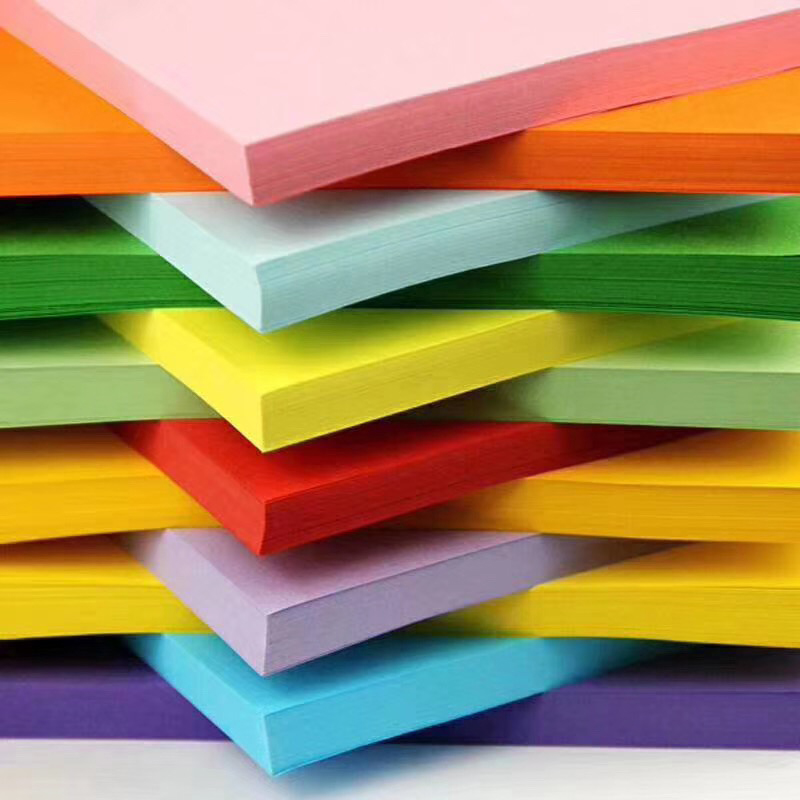
Understanding the physical properties of the substrate prevents structural failure. Single-wall corrugated boards provide excellent rigidity against bending due to the fluted medium. This makes them ideal for load-bearing applications. Heavy-duty chipboard offers dense, solid weight but lacks the compression resistance of corrugated options. Solid bleached sulfate (SBS) provides a smooth, premium printing surface but fails quickly under heavy loads.
Defining the GSM thresholds keeps your project standing. Materials between 200 and 300 GSM work well for scoring and folding complex geometric shapes without substrate cracking. For load-bearing structures like playhouses or display stands, you need materials exceeding 400 GSM. Utilizing a fluted core becomes mandatory to prevent buckling under weight.
Substrate Specification Comparison
Material Type | Typical GSM Range | Primary Structural Benefit | Ideal Project Application |
|---|---|---|---|
Solid-Core Dyed Board | 250 - 400 | Clean edge presentation, high fold memory | Architectural models, premium packaging |
Single-Wall Corrugated | 400 - 600+ | High compression resistance, lightweight | Retail displays, modular playhouses |
Heavy-Duty Chipboard | 600 - 1000 | Dense mass, impact resistance | Tabletop game boards, structural bases |
Standard SBS | 200 - 350 | Smooth surface finish, flexibility | Light folding cartons, printed mockups |
Fabricators often attempt to cut corners by gluing thin sheets to thicker raw boards. This introduces severe delamination risks. When evaluating standard color papers laminated to raw substrates, the adhesive layer becomes a point of failure. Bending or scoring the laminated board creates sheer stress. The top layer bubbles or detaches entirely.
Humidity makes this issue worse. Laminated substrates absorb moisture unevenly. The thin paper expands faster than the dense board beneath it, resulting in aggressive warping. Manufacturing processes where the pulp is dyed prior to pressing create a homogenous board. These boards react to environmental changes uniformly. They maintain their dimensional stability and eliminate the risk of surface peeling.
Material yield directly impacts project viability. Calculating waste reduction requires matching the raw material size to the fabrication equipment. Specifying standardized A4 sizes works perfectly for desktop plotters. It eliminates the need for manual breakdown of larger sheets. You save time and prevent inaccurate manual cuts that ruin the material edge.
Ordering 4x8 foot sheets is mandatory for CNC oscillating knife tables or large-format laser cutters. Utilizing large sheets for retail signage or playhouse components allows for seamless designs without structural joints. Joints act as inherent weak points. Nesting software optimizes the layout of complex parts on these large sheets. You maximize yield and minimize off-cut waste.
Environmental impact matters in modern fabrication and retail design. Assessing the footprint of pre-dyed boards versus painted boards reveals a stark contrast. Painting standard boards introduces aerosols, volatile organic compounds (VOCs), and microplastics into the shop environment. Heavily painted or vinyl-wrapped substrates often get rejected by municipal recycling facilities due to contamination.
Solid-core dyed boards utilizing water-based, non-toxic inks maintain a high degree of end-of-life recyclability. The dye integrates into the cellulose fibers without plastic laminates or heavy chemical sealants. The material re-enters the standard paper recycling stream easily. This makes it a superior choice for temporary event displays and eco-conscious packaging.
Cellulose fibers absorb and release moisture in response to ambient humidity. This characteristic causes dimensional instability. Shop environments fluctuate wildly in humidity. If you leave a stack of untreated boards on a concrete floor overnight, they will absorb the moisture and cup by morning. In high-humidity environments, untreated boards swell, warp, and lose their compression strength. A perfectly square architectural model distorts within days if left in a damp room.
Mitigating this risk requires proactive planning. Always store your materials flat on raised pallets and keep them wrapped in plastic until you are ready to cut. For long-term displays, specify boards treated with aqueous coatings that provide a moisture barrier. If you must use untreated boards, plan for climate-controlled deployment. Seal exposed edges with specialized adhesives to prevent moisture ingress through the highly porous cross-section of the board.
Lightfastness measures how well a dye resists fading when exposed to light. Standard commercial dyes used in mass-market boards suffer from rapid UV degradation. When placed in direct sunlight or under intense retail lighting, vibrant reds and blues shift to muted, washed-out tones within weeks. This destroys the aesthetic value of the project.
To mitigate UV damage, restrict untreated projects to short-term or indoor use away from direct windows. For archival art, topographical sculptures, or permanent museum installations, source acid-free, UV-resistant variants. These specialized boards utilize pigments rather than standard dyes, offering decades of color stability.
Creating strong joints requires matching the adhesive to the substrate's surface energy and porosity. Chemical compatibility varies wildly. PVA glues work exceptionally well on uncoated, porous boards. They create a bond stronger than the fibers themselves. Applying PVA to coated or heavily calendared finishes results in weak surface adhesion that fails under tension. Cyanoacrylates dry too brittle for flexible joints. Hot-melt adhesives add unwanted bulk to precision models.
Adhesive Compatibility Guide
Adhesive Type | Best For | Limitations |
|---|---|---|
PVA (Wood/White Glue) | Uncoated, porous boards | Fails on glossy or coated finishes; requires clamping time |
Cyanoacrylate (Super Glue) | Small, rigid detail parts | Brittle; snaps under flexing or heavy vibration |
Hot-Melt Adhesive | Rapid prototyping, hidden joints | Adds bulk; can melt under high display lighting |
Double-Sided Industrial Tape | Coated boards, clean aesthetics | Difficult to reposition once applied |
To reduce reliance on chemical bonds, implement mechanical fastening directly into the structural design. Designing interlocking tabs, slot-and-groove joints, or utilizing hardware like rivets and binding screws ensures the structure holds together under tension and load.
Procurement strategies dictate the financial feasibility of large-scale projects. Analyzing the cost per square inch reveals the divide between custom mill runs and off-the-shelf purchasing. Custom mill runs allow for exact Pantone matching. This ensures flawless brand precision for retail rollouts or corporate packaging. These runs require massive minimum order quantities, tying up capital and storage space.
Sourcing off-the-shelf packs from educational suppliers or specialized paper merchants offers immediate availability and low upfront costs. The trade-off is design flexibility. Fabricators must adapt their projects to stock colors. For prototyping, classroom use, or small-batch maker projects, the immediate availability of stock colors far outweighs the benefits of custom dye matching.
The physical density and thickness of the chosen substrate dictate the necessary equipment overhead. Laser cutters provide unparalleled precision for intricate designs. A standard 60W CO2 laser handles 2mm solid-core boards easily, but you need to dial in your speed and power settings to avoid edge charring. Pushing a low-wattage laser too hard results in burnt edges that smell like a campfire and ruin the visual presentation. Processing dyed materials requires robust ventilation systems to extract the resulting fumes safely.
For thicker corrugated materials, switch to a CNC router equipped with an oscillating tangential knife. This setup slices through the flutes cleanly at high feed rates without crushing the internal structure. Thicker, more durable boards increase the project's lifespan but accelerate tool wear. Fabricating heavy-duty boards requires high-wattage cutting equipment or frequent blade replacements. We recommend tungsten carbide blades for automated cutting plotters to maintain clean edges over long production runs. Factoring in these tooling requirements prevents unexpected downtime and budget overruns during the fabrication phase.
Audit your fabrication equipment capabilities, specifically checking maximum blade depth clearances and laser wattage limits against your desired material thickness.
Order material sample swatches to physically test scoring, folding tolerances, and kerf bending before committing to a final design.
Verify dye-lot consistency and UV lightfastness ratings with your supplier prior to executing a bulk purchase for long-term installations.
Design structural joints using mechanical tabs and slots to minimize reliance on adhesives in high-friction or load-bearing applications.
A: Cardstock typically maxes out around 300-400 GSM and lacks an internal fluted or multi-ply structure. Colored cardboard includes multi-ply chipboard or corrugated layers. This offers significantly higher rigidity, compression resistance, and load-bearing capacity for structural projects.
A: Generally, no. True cardboard is too thick and rigid to pass through the feed rollers of standard inkjet or laser printers. It requires specialized flatbed printers or desktop cutting plotters designed for heavy materials.
A: Use a fresh, high-carbon steel or tungsten carbide blade for manual or plotter cutting. For thicker corrugated materials, multiple shallow passes yield a cleaner edge than a single deep cut. A single deep cut tends to crush the internal flutes and tear the surface fibers.
A: Yes, provided you source materials that use water-based, non-toxic dyes. Always verify the manufacturer's safety certifications if the material will be used for interactive playhouses, educational manipulatives, or toys meant for young children.
A: It depends on the manufacturing process. High-quality boards use colorfast dyes that resist bleeding, but untreated boards may transfer pigment if soaked. Applying a clear acrylic or aqueous spray coating seals the surface and prevents moisture-induced color transfer.
A: High-tack PVA glue works best for uncoated boards because it penetrates the cellulose fibers to create a bond stronger than the material itself. For coated or glossy finishes, you need a specialized papercraft adhesive or double-sided industrial tape.


