Views: 0 Author: Site Editor Publish Time: 2026-07-08 Origin: Site
Selecting the wrong paper size leads to cluttered desks, cramped handwriting, or abandoned notebooks. You might buy a gorgeous ledger only to leave it gathering dust after just two weeks. We see this friction constantly when daily tools clash against real-world habits. "Everyday writing" requires a careful balance between desk footprint, portability, and adequate space for thought capture. You need enough room to write freely, yet small enough dimensions to stay mobile.
Moving beyond subjective preferences helps solve this dilemma permanently. We will evaluate standard dimensions against specific workflows, storage scalability, and format types. You will discover exactly how to measure your workspace needs accurately. We will also show you how to match these sizes to your daily habits for lasting productivity.
A5 and Half-Letter offer the highest versatility for standard note-taking, balancing portability with sufficient writing area.
B5 serves as the optimal middle ground for professionals who find A5 too restrictive but A4/Letter too large for shared workspaces.
Tear-off notepads in smaller dimensions (A6/Pocket) are highly efficient for transient data (to-do lists, quick capture) that doesn't require long-term archiving.
The ideal choice depends on a three-point framework: primary environment (desk vs. mobile), primary writing instrument, and archival requirements.
Before you purchase another notebook, you must establish clear success criteria for your daily habits. Evaluating your true needs prevents the common cycle of buying visually appealing stationery that ultimately fails in practice. A systematic evaluation relies on three foundational pillars.
You must assess how much workable space remains when a pad is fully open alongside your laptop and peripherals. Modern workspaces often feature multiple monitors, ergonomic keyboards, and secondary devices. Dropping a massive open ledger into this environment creates immediate physical friction. You might find yourself awkwardly resting your notebook over your keyboard edge. A high desk footprint ratio means the paper consumes too much prime real estate. You need a size that nests comfortably in the negative space of your desk setup. If you constantly shift items around just to jot down a quick thought, your paper size is too large.
Your ideal size depends heavily on how long you intend to keep the information. You must determine if your notes serve as a temporary reference or require permanent record-keeping. Transient notes include grocery lists, daily reminders, and quick phone numbers. These temporary tasks favor smaller, disposable formats. Conversely, archival notes include meeting minutes, project outlines, and journal entries. Permanent records favor standard, easily filed dimensions. Storing transient data in a massive, heavy-duty binder wastes space. Likewise, capturing important archival data on tiny, easily lost scraps creates organizational chaos.
People rarely consider how their favorite pen influences their ideal paper size. You must factor in how larger handwriting or broad-nib fountain pens require larger grid or line spacing. A broad pen naturally produces thicker, taller letters. If you use a broad pen on a tiny pocket pad, you will fill the entire page after just two sentences. This inherently demands a larger paper size to maintain standard word counts per page. Conversely, ultra-fine gel pens allow you to write tiny, legible text. This means you can comfortably use smaller sheets without feeling cramped. Always match your paper dimensions to the physical limits of your handwriting style and preferred ink.
Understanding global paper standards simplifies your organizational systems. Most high-quality Note Papers fall into either the ISO 216 standard (A-series and B-series) or traditional North American sizes. Mixing these systems often leads to misaligned binders and messy filing cabinets.
Format Standard | Dimensions (Inches) | Best Use Case | Primary Drawback |
|---|---|---|---|
A4 / US Letter | 8.3" x 11.7" / 8.5" x 11" | Mind mapping, stationary desk use | High desk footprint, poor portability |
A5 / Half-Letter | 5.8" x 8.3" / 5.5" x 8.5" | Meeting notes, daily journaling | Can feel restrictive for complex charts |
B5 (ISO/JIS) | 6.9" x 9.8" (approx) | Academic notes, deep-focus work | Less common, harder to find accessories |
A6 / Pocket | 4.1" x 5.8" / 3.5" x 5.5" | Field notes, retail environments | Unsuitable for long-form writing |
These are the dominant sizes in traditional corporate settings. A4 (8.3" x 11.7") and US Letter (8.5" x 11") offer massive, unrestricted canvases. They remain best for mind mapping, complex diagrams, and stationary desk use. You can easily capture an entire project overview on a single page. However, their drawbacks are significant for modern workflows. They demand a high desk footprint. They also suffer from poor portability for commuting. Trying to review an A4 notebook on a crowded train is incredibly frustrating.
A5 (5.8" x 8.3") and Half-Letter (5.5" x 8.5") dominate the personal productivity space. They are best for standard meeting notes, daily journaling, and hybrid work environments. The advantages heavily outweigh the compromises for most users. An A5 notebook fits in almost any standard bag or large purse. You can easily digitize these pages with smartphone scanners because they fit perfectly within a camera frame. They strike the ultimate balance between sufficient writing real estate and effortless mobility.
B5 (approximately 6.9" x 9.8") serves as the hidden gem of stationery. It is best for academic note-taking and deep-focus professional work. Many people find A5 just slightly too cramped, while A4 feels overwhelmingly large. B5 offers approximately 30% more surface area than A5 without the bulk of A4. You gain extra lines for expansive thoughts, yet the notebook still slides easily into a laptop sleeve.
A6 (4.1" x 5.8") and standard Pocket Sizes (3.5" x 5.5") are built for constant movement. They are best for field notes, retail environments, and standing workflows. You can comfortably hold them in one hand while writing with the other. The main drawbacks revolve around capacity. They are completely unsuitable for complex structural notes or long-form writing. You will find yourself flipping pages so frequently that you lose your train of thought.
Paper dimensions only tell half the story. The way pages bind together radically alters how a specific size behaves on your desk. A giant ring binder and a sleek stitched journal of the exact same paper size will feel completely different in practice.
Bound notebooks offer security and chronological continuity. Case-bound books lay flat and create a beautiful archival history of your thoughts. However, they demand their full open width on your desk. Spiral bindings provide a distinct implementation advantage. You can fold them back entirely on themselves. This effectively cuts their desk footprint in half. The main trade-off is ergonomic. The thick wire coils can severely interfere with your writing hand as you reach the inner margins.
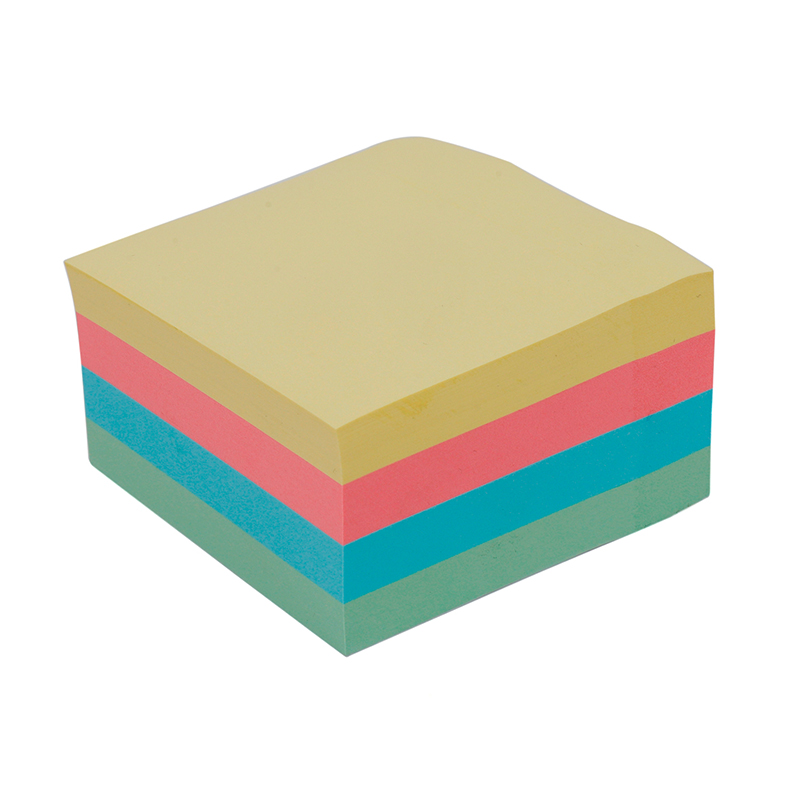
Sometimes you need information to disappear once completed. This is the strategic advantage of tear-off notepads. They are ideal for rapid task capture and immediate disposal or delegation. From a workflow integration perspective, small-format glued pads excel as secondary capture tools. You can keep them permanently nestled right beside your primary keyboard. When a random thought interrupts your digital work, you capture it instantly. Once you process the thought, you simply tear the page away and discard it. Top-bound variations completely eliminate hand interference for both left-handed and right-handed users.
Loose-leaf systems prioritize structural flexibility. They offer infinite modularity for people who constantly rearrange their notes. You can pull a page from last month and snap it next to today's agenda. However, this scalability requires strict discipline. It requires standardized hole-punching. This makes absolute adherence to strict ISO (A4/A5) or US standards mandatory for compatibility. If you try to force a random size into a standardized discbound system, the edges will protrude and quickly become damaged.
No single size works universally. Different daily responsibilities dictate completely different physical requirements. You must align your paper choice with your primary environment.
Managers spend their days shifting between deep work and constant meetings. They need a tool that handles both environments seamlessly.
Recommendation: B5 or A5 formats.
Why it works: These sizes provide enough space for complex meeting agendas and team rosters.
The advantage: They remain unobtrusive during one-on-one sessions. Pulling out a massive A4 ledger during a sensitive performance review can feel intimidating to the other person. An A5 book feels personal, discreet, and highly professional.
Creative and technical professionals need visual freedom. Structural constraints actively hinder their brainstorming processes.
Recommendation: A4/Letter blank sheets or large dot-grid pads.
Why it works: It prioritizes unrestricted space.
The advantage: Developers mapping out logic trees or designers sketching user interfaces need continuous visual flow. Margins and tight pages break concentration. A large, flat canvas allows an idea to expand organically without premature page turns.
People who work on their feet operate under strict physical constraints. Portability supersedes total capacity.
Recommendation: A6 or standard Pocket sizes.
Why it works: It prioritizes one-handed holding and rugged durability in transit.
The advantage: A field operator inspecting a construction site cannot use both hands to hold a floppy A4 book. They need a rigid, compact pad that slips instantly into a jacket pocket when they need their hands free. Total page capacity matters far less than sheer physical convenience.
Transitioning to a unified everyday writing system requires a methodical approach. Do not rush out to buy premium leather goods immediately. Follow this simple shortlisting logic to secure a functional, long-lasting setup.
Step 1: Measure your primary workspace. Sit at your desk in your normal typing posture. Measure the exact negative space below or beside your keyboard. Ensure your proposed paper size fits comfortably in this zone while fully open. If it overlaps your mousepad, scale down immediately.
Step 2: Audit your current "abandoned" notebooks. Pull your half-used notebooks out of your drawers. Analyze why you stopped using them. Identify if past failures were due to feeling cramped on the page, or if you got tired of lugging unnecessary weight in your bag. Let past friction guide your future choices.
Step 3: Test with low-risk formats. Never buy an expensive binder system before verifying the size works for you. Buy inexpensive, disposable pads in A5 and B5 first. Use them exclusively for two weeks. Verify that your hand doesn't cramp and your bag doesn't feel heavy before committing to premium leather-bound systems.
Step 4: Standardize your system. Once you find your ideal fit, commit entirely to one ecosystem. Choose either the ISO standard or the North American standard. This single decision ensures future compatibility with file folders, ring binders, and long-term storage boxes. Mixing systems guarantees future frustration.
There is no universal "best" size for daily tasks, only the most efficient size for your specific workflow. Standardizing your approach eliminates daily friction and prevents you from accumulating unused stationery. Start your standardization process by evaluating your primary workspace constraints and your long-term archival needs. Measure your desk space, audit your handwriting size, and test inexpensive formats first. Audit your daily note-taking habits today to select a reliable primary size, like an A5 bound book, paired seamlessly with a supplementary size, like an A6 disposable pad.
A: Compare your daily word count habits to decide. A5 is ideal for concise, daily summaries and quick reflections. It fills up quickly, providing a psychological sense of accomplishment. Conversely, B5 accommodates highly expansive, long-form reflection. It allows you to write extensive daily entries without frequent, disruptive page-turning.
A: Top-binding entirely eliminates hand-interference at the margins. This accommodates both left and right-handed writers perfectly. Additionally, it facilitates a much smaller desk footprint when referencing previous pages. You simply flip the used page straight up and over the top, keeping the pad's horizontal width perfectly compact.
A: Yes. Broader nibs, like certain fountain pens or bold markers, require wider line spacing (typically 7mm to 8mm or more). This naturally reduces the total lines available per page. Users preferring broad pens often need to scale up one paper size (for example, moving from A5 to B5) to maintain their normal volume of notes per page without feeling cramped.
A: Not efficiently. Mixing them introduces severe physical risks. Edges will stick out of folders, leading to bent and torn pages. Furthermore, hole-punch alignments rarely match up between the two standards. We highly recommend committing entirely to one single standard ecosystem for all your long-term archiving to maintain structural integrity.